
BOOKS I LOVE
  • Slob
    Slob
    by Ellen Potter
  • Amazing Grace
    Amazing Grace
    by Megan Shull
  • The Case of the Missing Marquess: An Enola Holmes Mystery
    The Case of the Missing Marquess: An Enola Holmes Mystery
    by Nancy Springer
  • Petropolis
    Petropolis
    by Anya Ulinich
  • How I Live Now
    How I Live Now
    by Meg Rosoff
  • Infernal Devices (The Hungry City Chronicles)
    Infernal Devices (The Hungry City Chronicles)
    by Philip Reeve
  • The Clay Marble (Sunburst Book)
    The Clay Marble (Sunburst Book)
    by Minfong Ho
Monday
08Mar2010

That Giant Wastebasket in the Sky

Last week I came across an intriguing piece of advice for writers: "Never throw anything out." "Uh oh," I thought, "I'm in trouble." I've been ripping, tearing, shredding, burning, crossing out, and tossing things in the trash for as long as I can remember. My first memory of getting rid of writing comes at age seventeen. I had just broken up with my boyfriend. With a hurt look on his face, he handed me back a packet of letters I had written him. I didn't bother to read them over, but headed straight out to the burning barrel in our backyard. 

Later in life, I was to toss not only love letters from unhappy relationships, but also ordinary letters, diaries, journals, first drafts of stories, second drafts, third drafts (you get the idea), etc. etc. I began to joke about "that giant wastebasket in the sky" which contained all the material I had thrown out in my life. I never saw the point of saving multiple drafts of any book. Once the final book was published, I destroyed all the earlier versions. Of course, there were things I saved, as well. I still have a few of my earliest writings, such as "The Cowboy Coloring Book" that I wrote and illustrated at age 6 for my brother. I have dream diaries, a few travel journals, my son and daughter's stories, and every single letter that kids have written me about my books. I've never thrown out any poem I've written, either.

Have I ever regretted anything I destroyed? Of course, I have. Now I wish I had those letters written by my seventeen year old self. I wish I had my early journals. It never occurred to me as I was burning, tearing, or shredding, that someday I might be curious about my younger self. However, I've never regretted getting rid of manuscript drafts or unsuccessful stories. Getting rid of old things often frees me up for what's ahead. I don't want to hang onto every little scrap of writing as if it's my most precious treasure. Even if I lose a few good ideas along the way, it's okay. What's on paper is finite, but what's inside the brain is infinite...

Tuesday
23Feb2010

A Writer's Best Friend is... Failure?

If you think writing is all about success, you're wrong. Writing is just as much about failure as success. In the right doses, it can be a writer's best friend. 

What are your favorite books about? Are they about perfect people living perfect lives? Are they about kids or adults who effortlessly achieve one brilliant success after another? Can you imagine anything more boring? And do you know of any writer, who, when asked, "What inspired you to write?" answers, "I was inspired by my perfect life?" or, "I was inspired by my string of successes?"

Um, no. Most of us say things like, "I was the class misfit," or "I spent hours alone in my room and turned to books for consolation." Or "I lived in an imaginary world and everyone thought I was crazy until I started writing..."

Mr. Frog

Have you also ever noticed that the most inspiring, positive stories are filled with sadness and death, and the funniest stories are about painful, humiliating events? In 7th grade, I was chosen to serve tea to an honored guest on Career Day. I proceeded to drop a laden tea tray right into his lap. The humiliation of that moment was seared into my memory - and years later, I used it in a scene in The Accidental Witch, one of my first novels. Failure can be one of a writer's biggest inspirations. 

Failure is also an intrinsic part of the writing process. What is revision other than failing to write a perfect story the first - or the second - or the third - or the thirty-third time around? Yep, that's what we writers do. We fail all day long. And then we fail some more. Cheerful, isn't it?

Trying to get published at first often amounts to a string of seemingly endless rejections. EVERY writer, without exception, gets rejected at some point or other in his or her career. I fondly remember one of my early rejections. The book was called "The Crinkle in the Puddle" (don't ask!) and one editor wrote me, "The puddle doesn't have enough personality." "It's a puddle," I remember exclaiming. "It doesn't HAVE a personality!" Needless to say, the book was never published. 

When a writer finally succeeds at publishing a book, there is often more failure awaiting him or her. Reviewers may recoil in horror. "Take away her writing license!" That's what I always imagine a reviewer thinking when they really hate one of my books. Or, "She shouldn't be allowed unsupervised near any alphabet!" Sometimes the reviewers like a book, but the readers hate it. Or sometimes everyone loves it, but no one buys it. What's worse than selling only 22.8 copies of your masterpiece?

I'll tell you where failure really comes in handy, though. It's great for beginning writers. In fact, it should be required. Nothing is worse than seeing a writer with a string of early successes get lazy and arrogant. It's so disappointing - and a waste of good talent! After one of my first picture books, The Salamander Room, sold out its first few printings in a few months, and got stellar reviews everywhere, I imagined myself in a steady rise to the top of the children's book world, with one dazzling success after another. Then my next book, The Oxboy, which I still consider one of my best, flopped. So did my next seven or eight books. As painful as the experience was, it changed my approach in a very positive way. I never again considered success to be my due. When I write a book, I put my best efforts into it, knowing that it might always fail. Carrying that knowledge is part of what it means to be a writer. 

You wouldn't want to have twenty years of nothing but failure. That would be awful! But don't be afraid of failure. It's part of any writer's life. 

Friday
19Feb2010

Teaching Kids to Romp on the Page

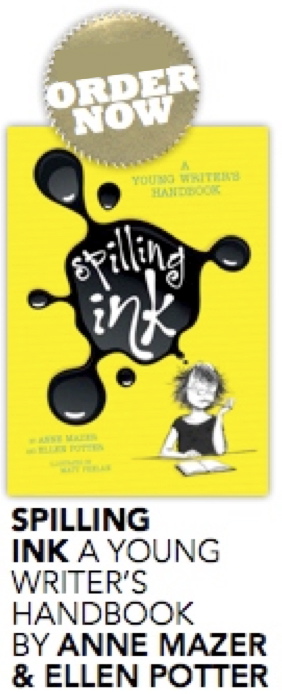
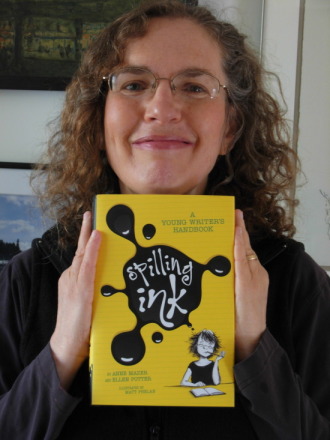
DON'T MISS THIS! Check out  Ellen Potter's wonderful new post: "Teaching Kids to Romp on the Page" at the MacBook blog, about why she wrote Spilling Ink. (With me, of course!)

Sunday
14Feb2010

The Five Best Things I Learned About Writing, I Learned While Asleep

Growing up, my daily wake-up call was the sound of two big electric typewriters. I could hear their furious clicks, dings, and noisy swings as I emerged from sleep, and knew that my parents were writing in their bedroom on the other side of the house. They had a comforting rhythm and reassured me that all was well. From kindergarten to middle school, I awoke to these sounds, until my parents finally earned enough money so that my father could quit his job and they could both start writing during the day. Then the typewriters pounded behind two locked doors. But to me as a child, writing was boring, obsessive and isolating. My own interests lay in reading. (Strangely, I never connected the two.) I read everything in my path, like a kind of devouring book machine, and never thought about those two noisy typewriters or what they might be saying to me. Years later, when I decided to start writing myself, I realized how much I had learned:

1. If you want to be a writer, WRITE! 

My parents talked about it for many years, but finally they sat down and did it. They wrote every morning, no matter what. It took them years, but they were finally able to achieve their dream of becoming full time writers.

2. Set up a schedule. 

Don't leave your writing to chance; make sure you have a dedicated time every day. My parents started with early morning writing sessions; I started with late evening ones. (There was no way I was getting up at 4:00 a.m.!)

3. You might have to fight for your time.

No, they didn't have to wrest the hours from our slippery little fingers, they probably had to fight their own fatigue and urge to sleep. My father had a full-time job and my mother was engaged in caring for three young children, all under the age of five. But they still managed to carve out the time to write. When you start to write, obstacles always seem to pop up. Don't be afraid to fight for your time!

4. Make writing a habit.

Once writing is a habit, everything becomes much easier. You don't have to think about it, schedule it, fight for it, you just DO it. It becomes part of your nature. I am, therefore I write. I saw my parents turn writing into a habit, and after many years of adhering to a writing schedule, I did, too. After a while, writing was so deeply a part of me, that even if I wanted to stop, I couldn't.

5. Writing is a slow process.

One of the best things I learned from waking up every morning to my parents' typewriters was how long everything takes. It takes a long time to write a book; it takes a long time to publish one. I never expected quick results or easy success. My parents wrote for at least seven years before they were able to make a living at it. It was another five or six years before they published their first young adult novel. 

Finally, let me give thanks to the typewriter gods, wherever they are. If my parents had been using computers, the gentle tapping of a computer keyboard would never have reached me at the other end of the house, and I wouldn't have learned some of the most important lessons of my writing life.

Sunday
07Feb2010

The Magical Mystery Book Tour

Daniel Pinkwater's The Snarkout Boys and the Avocado of Death is one of my favorite books. In fact, it's one of the books that I'd like to actually go live inside for a while. Reading the book, I just wanted to slither inside the pages and spend a few evenings snarking out with Walter and Winston Bongo. Another book that I'd like to live inside is Ellen Potter's Olivia Kidney and the Exit Academy. (No, I'm not just saying this because she's my friend. I want to row around the exit academy livingroom in a gondola. Wouldn't you?) The Twilight of Magic by Hugh Lofting was one of my most beloved childhood books and I think I actually DID live inside that one for a while. I thought I had a shell that would get hot and burn my hands when anyone was talking about me.

I've always dreamed of escaping to the world of books for real. Although I'd have to be choosy. There are books that I loved reading, but that I WOULDN'T want to visit, like the boot camp in Louis Sachar's Holes, the organ harvesting farm in Nancy Farmer's House of the Scorpion, and the starved, terrified wizard academy in Kathleen Duey's Skin Hunger . 

And then there are the artists. Don't get me started on the artists... When I was a kid, I loved the moody woodcuts of Fritz Eichenberg (Jane Eyre and Wuthering Heights) and the fairy tale illustrations of Kay Nielsen (East of the Sun and West of the Moon). I stared at the illustrations for hours, maybe days; there's probably a section of my brain cordoned off by rope and neon signs, that is solely dedicated to those two artists...

Come to think of it, I've been on the magical mystery book tour for most of my life. That's why I write. Because the only way to REALLY live inside a book is to write one. Try it out and see for yourself.

P.S. Which books/illustrations would you like to live inside? And why?

East of the Sun, West of the Moon by Kay Nielsen